Plastic Tripod Magnifier Manufacturer,Supplier and Exporter in India

Product Code : SCL-M-11552
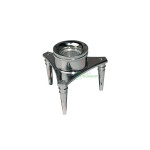
The Plastic Tripod Magnifier is a precision-calibrated
inspection tool engineered for hands-free macro-analysis of biological
specimens and geological samples. Designed for Secondary and Vocational (TVET)
laboratory environments, this 10x magnification system utilizes a screw-thread
focal adjustment to meet ISO 9001:2015
quality standards. It facilitates stable, high-resolution visualization for
university-preparatory curricula.
Technical Specifications
|
Tender Specification |
OEM Technical Detail |
|
Material Grade |
Optical-grade Glass (Lens) /
Industrial-grade Polymer & Metal Chassis |
|
Magnification Power |
10x Fixed |
|
Lens Diameter |
1" (25.4mm) |
|
Focal Adjustment |
Screw-thread holder for
precision depth-of-field control |
|
Base Support |
Metal tripod frame for
vibration-resistant observation |
Key Pedagogical Outcomes
·
10x Calibrated Glass Lens: Enables students to Evaluate micro-morphological structures in
entomological and botanical samples, supporting Synthesis of
biological classification.
·
Metal Tripod Base:
Facilitates the Application of hands-free dissection and measurement
protocols, allowing for stable specimen manipulation without focal drift.
·
Screw-Thread Focal Holder: Allows students to Analyze
surface relief and topographical variations by fine-tuning the focal plane,
reinforcing Analysis of material properties.
International Logistics & Compliance
This School Instrument is consolidated for international B2B
procurement via export-grade seaworthy crating (ISPM-15
compliant). Each unit is individually packaged in shock-absorbent
housings and vacuum-sealed to mitigate atmospheric oxidation of the metal base
during maritime transit. Documentation provided to procurement officers
includes the Manufacturer’s Authorization Form (MAF), Certificate of
Quality (CoC), and User Manuals in English. The tropicalized design
is verified for structural and optical integrity in environments reaching 45°C and 90% Humidity, ensuring that the
glass-to-polymer screw threads remain operational in equatorial laboratory
settings.