Tongs, Beaker 2 Manufacturer,Supplier and Exporter in India

Product Code : SCL-LE-11747
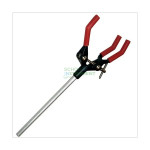
The Stainless Steel
Beaker Tongs are engineered for the high-stability manipulation of heated
borosilicate vessels. Optimized for University and Vocational TVET curricula,
these instruments provide a high-friction grip for safe beaker transfer during
exothermic reactions or thermal activation. They meet international safety
standards for corrosive-environment handling and manual laboratory dexterity.
Technical Specifications
|
Tender Specification |
OEM Technical Detail |
|
Material Grade |
Grade 304/316 Stainless Steel
Wire |
|
Structural Architecture |
Scissor-Action Cross-Link
with Curved Jaws |
|
Finish |
Fine-Polished Anti-Corrosive
Surface |
|
Grip Interface |
Ergonomic Finger Loops for
Precision Torque |
|
Durability Rating |
High Heat Resistance;
Chemical Neutrality |
Key Pedagogical Outcomes
·
Curved
Jaw Geometry: Provides 360-degree radial
support for cylindrical beakers, mitigating the risk of mechanical slippage
during "Quantitative Analysis" modules.
·
Stainless
Steel Composition: Resists oxidation and
acidic degradation, teaching students the principles of "Material
Science" and long-term equipment maintenance in chemistry labs.
·
Fine-Polished
Pivot Points: Ensures smooth,
stutter-free articulation, supporting Bloom's "Psychomotor" domain by
allowing students to execute delicate liquid transfers without spillage.
·
Extended
Wire Reach: Maintains a safe ergonomic
distance between the operator and thermal sources, ensuring compliance with
institutional "Safety and Hazard Management" modules.
International Logistics & Compliance
This instrument is prepared for high-volume institutional
distribution, utilizing export-grade seaworthy crating (ISPM-15
compliant) with industrial moisture-barrier liners. Every
procurement lot includes the Manufacturer’s Authorization Form (MAF),
IQ/OQ/PQ Certification protocols upon request, and User Safety Manuals in
English. The tropicalized design
is tested for finish persistence and structural integrity in environments
reaching 45°C and 90% Humidity,
ensuring long-term resistance to saline corrosion and fungal growth.