Solar System Model Manufacturer,Supplier and Exporter in India
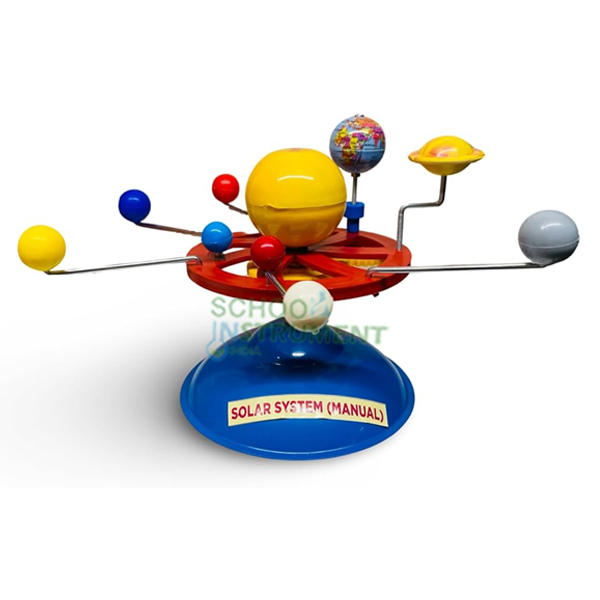
Product Code : SCL-LE-11189
This three-dimensional
solar system model is engineered for the spatial analysis of planetary orbits
and relative celestial positioning in Secondary and Vocational educational
environments. Mounted on a high-stability chassis, it facilitates the demonstration
of heliocentric theory and orbital inclination. It complies with institutional
standards for durable pedagogical apparatuses designed for long-term laboratory
deployment.
Technical
Specifications
|
Tender Specification |
OEM Technical Detail |
|
Material Grade |
Impact-Resistant Synthetic Polymer / Reinforced Alloy Hardware |
|
Mounting Interface |
Sturdy, Weighted Heavy-Duty Pedestal Base |
|
Dimensional Profile |
24" x 14" x 11" |
|
Mapping Documentation |
Integrated Technical Key for Planetary Identification |
|
Shipping Weight |
3 Lbs. |
Key Pedagogical
Outcomes
· Three-Dimensional Orbital Array: Enables students to analyze the spatial relationships and distance
scaling between celestial bodies, supporting Earth Space Science.
· Rotating Planetary Components: Facilitates the Evaluation of orbital periods and planetary
rotation, allowing learners to Model complex
seasonal cycles and lunar phases.
· Integrated Identification Key: Supports the Knowledge acquisition of planetary nomenclature
and physical characteristics through direct tactile reference.
· Ruggedized Centric Mounting: Allows students to apply heliocentric principles during group-based
laboratory "Synthesis" of astronomical datasets.
International
Logistics & Compliance
To satisfy the
requirements of international B2B procurement, these models are secured in
impact-absorbent inner housings and secondary export-grade seaworthy crating
(ISPM-15 compliant). Technical documentation provided with all consignments
includes the Manufacturer’s Authorization Form (MAF), IQ/OQ/PQ Certification of
structural integrity, and User Manuals in English. The hardware features a
tropicalized design; all polymer substrates and metallic articulating
components are tested for structural stability in environments reaching 45°C
and 90% humidity to prevent warping or corrosion.