Litmus Paper Manufacturer,Supplier and Exporter in India
Product Code : SCL-LE-11305
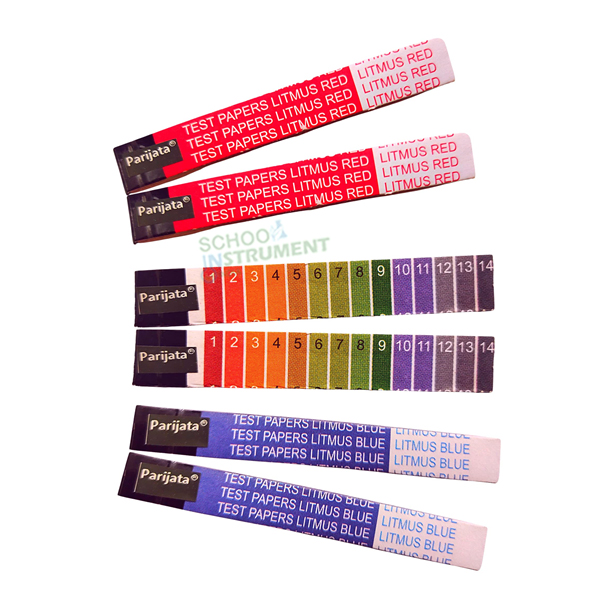
Litmus Indicator
Strips are engineered for the rapid, qualitative identification of acidic and
alkaline reagents. Designed for Secondary and Vocational TVET curricula, these
cellulose-based strips provide binary colorimetric shifts to facilitate
introductory chemical analysis. All variants comply with ISO quality protocols
for high-sensitivity response to hydrogen and hydroxyl ion concentrations in
aqueous solutions.
Technical
Specifications
|
Tender Specification |
OEM Technical Detail |
|
Material Grade |
High-Absorbency
Indicator-Impregnated Cellulose |
|
Available Variants |
Red (Basic Detection), Blue
(Acidic Detection), Neutral |
|
Strip Dimensions |
2" Length x 1/4"
Width (approx. 50mm x 6mm) |
|
Packaging Configuration |
100 Strips per Polypropylene
Vial |
|
Reaction Threshold |
Binary Color Shift
(Red-to-Blue / Blue-to-Red) |
|
Chemical Protection |
Hermetically-sealed UV-opaque storage vial |
Key Pedagogical
Outcomes
·
Binary Colorimetric Shift: Allows students to "Analyze" and classify
unknown substances into acidic or basic categories, supporting Chemistry.
·
High-Sensitivity Impregnated
Litmus: Facilitates the
"Evaluation" of neutralization reactions during titration prep,
ensuring the correct application of chemical indicators.
·
Specialized Neutral Variant: Enables students to "Synthesize" observations
regarding amphoteric or balanced pH states without requiring secondary testing.
·
Polypropylene Vial Housing. Supports the "Application" of long-term
laboratory preservation techniques, maintaining indicator reactivity across
multiple academic terms.
International
Logistics & Compliance
To satisfy
international B2B procurement standards, these indicator strips are prepared in
export-grade seaworthy crating (ISPM-15 compliant). Standardized documentation
includes the Manufacturer’s Authorization Form (MAF), Safety Data Sheets (SDS),
and Technical User Manuals in English. The product features a tropicalized
design; chemical impregnation is stabilized to prevent degradation in
high-humidity environments, tested for reliable shelf-life in temperatures up
to 45°C and 90% humidity.