Forms of Bacteria Model Manufacturer,Supplier and Exporter in India
Product Code : SCL-LE-12284
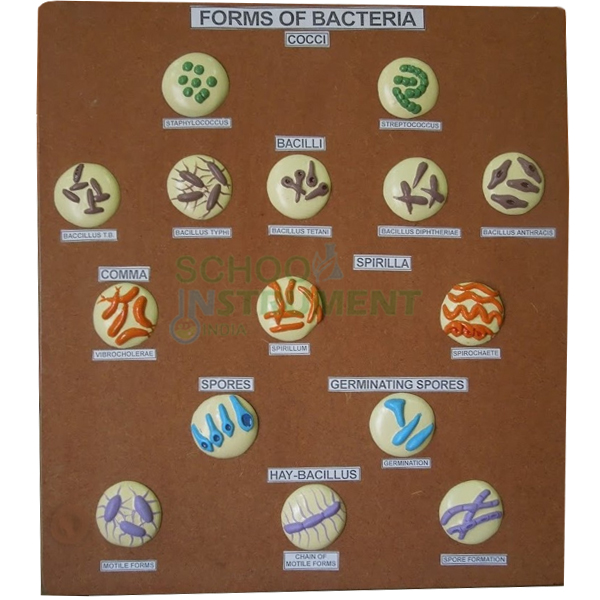
This high-relief,
extraordinarily enlarged anatomical model is engineered for the granular
identification of bacterial morphologies within Secondary and Vocational life
science frameworks. Complying with standard pedagogical requirements for
microbiology, the model facilitates the tactile and visual differentiation of
cocci, bacilli, and spiral forms. It serves as a durable, three-dimensional
alternative to 2D diagrams, ensuring high-retention learning of cellular
structures in high-density classroom environments.
Technical Specifications
|
Tender Specification |
OEM Technical Detail |
|
Model Type |
Enlarged Three-Dimensional
Morphology Set |
|
Material Composition |
High-Impact, Medical-Grade
PVC (Phthalate-Free) |
|
Mounting |
Reinforced
Polypropylene/Wooden Base for Stable Display |
|
Dimensions |
Optimized for 360-degree
visibility in 30+ student lecture halls |
|
Coating |
Non-toxic, UV-resistant,
chip-resistant pigments |
Key Pedagogical Outcomes
·
Extraordinarily Enlarged Scalar Representation: Enables macroscopic analysis of microscopic
structures, allowing students to identify surface characteristics of bacteria
without the limitations of standard light microscopy.
·
Multi-Form Comparative Layout (Coccus,
Bacillus, Spirillum): Facilitates rapid taxonomic classification
exercises, supporting Bloom’s Taxonomy Level 2 (Understanding) and Level 4
(Analysis).
·
Rigid, High-Contrast Surface Textures: Supports tactile learning for inclusive
education, allowing students to physically trace flagellar or capsular
structures.
·
Integrated Fixed Base: Ensures equipment longevity during
high-frequency handling in "Station-Rotation" lab practical.
International Logistics & Compliance
Designed for global
distribution, this School Instrument is housed in export-grade, seaworthy
crating (ISPM-15 compliant) to prevent transit damage. Each unit is accompanied
by a Manufacturer’s Authorization Form (MAF) and comprehensive English-language
instructional guides. The structural integrity of the PVC and pigments is
tropicalized, tested for continuous exposure in high-temperature (up to 45°C)
and high-humidity (90%) environments, ensuring zero deformation or pigment
leaching in diverse geographical climates.