Cross Vertical Staff Model Manufacturer,Supplier and Exporter in India
Product Code : SCL-ELE-12022
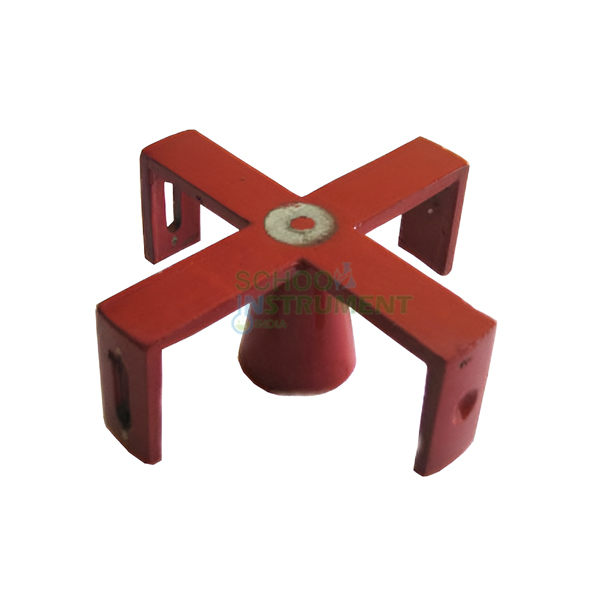
The Cross Vertical
Staff Model is a precision-calibrated field instrument engineered for the
empirical verification of right-angle offsets and perpendicular alignments in
land surveying. Designed for Secondary and Vocational TVET levels, it
facilitates the practical application of Euclidean geometry in civil
engineering modules under ASTM pedagogical standards. This ISO-compliant model
ensures structural rigidity for high-frequency institutional field exercises.
Technical Specifications
|
Tender Specification |
OEM Technical Detail |
|
Material Grade |
Ruggedized
Corrosion-Resistant Alloy / UV-Stabilized Polymer |
|
Operational Configuration |
Fixed Cross-Head with
Integrated 90° Sighting Slots |
|
Dimensions |
Standardized Laboratory Scale
for Tactical Field Simulation |
|
Mounting Interface |
Calibrated Threaded Socket
for Universal Tripod/Staff Attachment |
Key Pedagogical Outcomes
·
Precision-Milled
Sighting Slots: Allows students to
establish orthogonal baselines with high angular accuracy, supporting in
"Applied Geometric Synthesis."
·
Rigid
Cross-Head Alignment: Facilitates the
empirical derivation of offsets from a chain line, supporting "Civil
Engineering and Surveying."
·
Tactical
Staff Mounting: Enables the
visualization of 3D spatial positioning and horizontal leveling, reinforcing
"Coordinate Mapping and Technical Data Collection."
International Logistics & Compliance
To maintain the axial
alignment of the sighting slots and prevent alloy oxidation during
transcontinental maritime transit, all units are secured in high-density
moisture-barrier primary packaging and consolidated in export-grade seaworthy
crating (ISPM-15 compliant). International procurement documentation includes
the Manufacturer’s Authorization Form (MAF), Certificate of Conformance (CoC),
and Laboratory User Manuals in English. The instrument features a tropicalized
design, batch-tested for operational stability in environments reaching 45°C
and 90% Humidity to ensure zero material warping or structural degradation in
extreme climates.