Cobalt Glass Plates Manufacturer,Supplier and Exporter in India
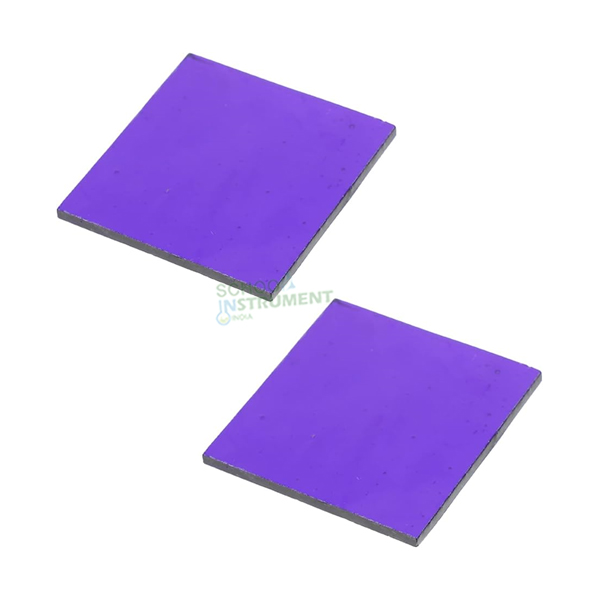
Product Code : SCL-LE-11308
Cobalt Glass Filter
Plates are engineered for the optical suppression of sodium-line interference
(589 nm) during qualitative flame spectroscopy. Designed for University and
Secondary laboratory environments, these high-density filters enable the clear
visualization of potassium’s violet emission. All units comply with ASTM
spectral filtration standards for evidentiary chemical analysis and are
optimized for high-temperature instructional use.
Technical
Specifications
|
Tender Specification |
OEM Technical Detail |
|
Material Grade |
High-Purity Cobalt-Doped
Optical Glass |
|
Spectral Function |
Selective Absorption of
Yellow/Orange (Sodium) Wavelengths |
|
Dimensions |
Standardised
Square/Rectangular Format (Sized for Handheld Field-of-View) |
|
Optical Density |
Calibrated for
Flame-Excitation Observation |
|
Quantity per Unit |
6 Plates per Pack |
Key Pedagogical
Outcomes
·
High-Attenuation Cobalt Doping: Allows students to "Analyze" and identify
potassium ions in complex mixtures by effectively masking dominant sodium
contaminants.
·
Broad Spectrum Blue Filter: Facilitates the "Evaluation" of emission
spectra, enabling the "Analysis" of the Bohr model and electron
transition states within inorganic chemistry modules.
·
Thermal Shock Resistance: Supports safe handheld "Application" near open
Bunsen burner flames, ensuring consistent data collection across multiple
laboratory trials.
·
Multi-Pack Distribution (Pack
of 6): Enables individual student
"Evaluation" of unknown salts, supporting independent learning and
evidentiary reasoning in Qualitative.
International
Logistics & Compliance
To ensure arrival
integrity for international B2B procurement, these filters are secured in
export-grade seaworthy crating (ISPM-15 compliant) featuring high-density
anti-scratch dunnage. Comprehensive documentation packages include the
Manufacturer’s Authorization Form (MAF), Certificates of Conformity (CoC), and
Safety Data Sheets (SDS) in English. The glass plates feature a tropicalized
design; the optical doping remains stable in environments tested up to 45°C and
90% humidity, preventing the solarization or oxidative degradation common in
lower-grade films.