Policeman, Rubber Manufacturer,Supplier and Exporter in India

Product Code : SCL-ELE-11913
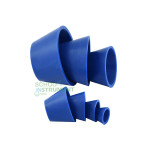
The Rubber Policeman
is engineered for the complete mechanical recovery of precipitates from glass
surfaces during gravimetric analysis. Optimized for University and Vocational
technical curricula, this instrument features a 5mm internal bore for secure
integration with standard glass stirring rods. It ensures compliance with
analytical precision standards by mitigating sample loss during quantitative
transfers in secondary and tertiary laboratories.
Technical Specifications
|
Tender Specification |
OEM Technical Detail |
|
Material Grade |
Vulcanized Natural Rubber /
Chemical-Resistant Elastomer |
|
Internal Bore Diameter |
5mm (Calibrated for standard
lab rods) |
|
Geometry |
Angled/Chisel tip for
maximized surface contact |
|
Chemical Resistance |
Stable against dilute acids,
bases, and aqueous solvents |
Key Pedagogical Outcomes
·
5mm
Precision Bore: Allows students to
convert standard stirring rods into specialized scraping tools, supporting
"Apparatus Adaptation" and "Modular Lab Design" modules.
·
Flexible
Elastomeric Chisel Tip:
Enables the total mechanical removal of solid residues from beaker walls,
supporting Bloom's Taxonomy in "Quantitative Chemical Analysis" and
"Gravimetric Accuracy."
·
Friction-Fit
Seal: Prevents reagent
ingress between the rod and rubber interface, reinforcing "Contamination
Control" and "Standard Operating Procedures (SOP)" in Vocational
training.
International Logistics & Compliance
To ensure material
longevity and prevent oxidative perishing during transcontinental maritime
transit, all units are secured in moisture-barrier primary packaging within
export-grade seaworthy crating (ISPM-15 compliant). International procurement
documentation includes the Manufacturer’s Authorization Form (MAF), Certificate
of Conformance (CoC), and User Manuals in English. The component is fully
tropicalized; the elastomer substrate is batch-tested for ozone resistance and
thermal stability in environments reaching 45°C and 90% Humidity to eliminate
the risk of structural hardening or surface tackiness.