Semi-Circular Lens Manufacturer,Supplier and Exporter in India
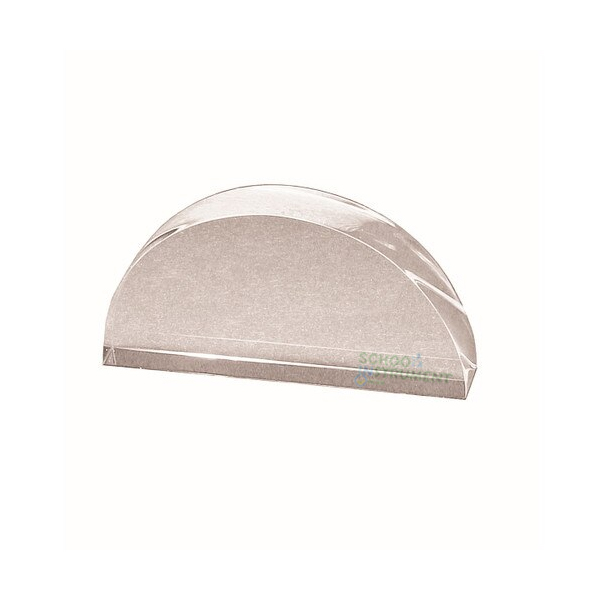
Product Code : SCL-M-11548
The Semi-Circular Refractive Lens is a precision-machined
optical component engineered for the quantitative analysis of refraction and
internal reflection. Designed for University and Secondary
physics curricula, this instrument facilitates high-accuracy measurement of the
critical angle and refractive index in compliance with ISO 9001:2015 quality standards. It is optimized for
ray-tracing modules and laser-path visualization.
Technical Specifications
|
Tender Specification |
OEM Technical Detail |
|
Material Grade |
Optical-grade Dielectric
Acrylic (PMMA) |
|
Base Dimension |
75 mm |
|
Thickness |
15 mm |
|
Geometry |
Semi-Circular (D-Lens) with
polished refractive faces |
|
Surface Regularity |
Calibrated for minimal beam
scattering |
Key Pedagogical Outcomes
·
75mm Planar Base: Enables students to Evaluate the
transition of light from a denser to a less dense medium, supporting Synthesis of Total Internal Reflection (TIR)
principles.
·
15mm Optical Thickness: Facilitates the Analysis of ray
paths using standard laboratory laser diodes or ray boxes without significant
vertical beam parallax.
·
Polished Acrylic
Substrate: Students Apply Snell’s Law to
derive the refractive index of the material, reinforcing Application of trigonometric physics.
International Logistics & Compliance
This School Instrument is consolidated for international
procurement via export-grade seaworthy crating (ISPM-15 compliant).
To maintain optical clarity, each lens is individually protected by a
scratch-resistant PE film and vacuum-sealed in moisture-vapor barrier packaging
to prevent polymer clouding during maritime transit. Documentation provided to
procurement officers includes the Manufacturer’s Authorization
Form (MAF), IQ/OQ/PQ Certification, and technical data sheets in
English. The tropicalized design is verified for dimensional
stability in environments reaching 45°C and 90% Humidity,
ensuring the lens remains free from warping or thermal degradation in
equatorial climates.