
Anemometer Manufacturer,Supplier and Exporter in India
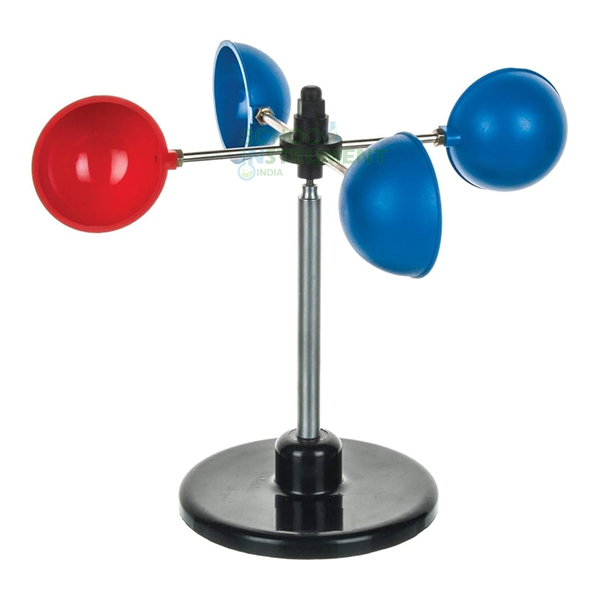
Product Code : SCL-ELE-11021
Our Robinson-style cup
anemometer is engineered to transform kinetic wind energy into measurable
rotational frequency. By utilizing a four-cup design, the instrument maintains
high torque and consistent rotation even in turbulent or low-speed conditions.
|
Feature |
Specification |
|
Operational Principle |
Rotational velocity
proportional to linear wind speed |
|
Rotor Configuration |
4-Cup system (45 mm – 50 mm
diameter per cup) |
|
Dimensions |
210–220 mm (Height) x 150–160
mm (Width) |
|
Material Composition |
High-grade,
corrosion-resistant polymers and alloys |
|
Visual Indicators |
3 Blue cups / 1 Red cup
(High-contrast for manual counting) |
|
Safety & Compliance |
Non-toxic materials, zero
removable parts, permanent English labeling |
Engineering Excellence: Why Factory-Direct Matters
1.
Ultra-Low
Start-up Threshold: Our in-house
machining allows for the production of high-sensitivity, low-friction axles.
These units are calibrated to begin rotating with a simple human blow, making
them ideal for demonstrating the Betz's Law concepts and the principles of Anemometry.
2.
Durability
in Laboratory Environments:
By controlling the chemical composition of our plastics and coatings, we ensure
our instruments withstand the corrosive atmosphere of chemistry labs and the
physical rigors of outdoor STEM field testing.
3.
Traceability: Every unit is permanently branded and marked.
This ensures long-term accountability and alignment with international
educational standards.
Scientific Context & Applications
The cup anemometer
remains a standard for wind speed measurement due to its independence from wind
direction. Research indexed in Google Scholar emphasizes that the accuracy of
these devices depends heavily on the "cup constant" and the
minimization of mechanical drag—areas where our factory-controlled precision
engineering excels.
·
STEM
Education: Visualizing the
relationship between air pressure and rotational frequency.
·
Meteorology: Basic wind speed logging and weather station
integration.
·
Physics
Experiments: Studying rotational
inertia and mechanical friction.


.jpg)

